


How Paper Cups Are Made: Step-by-Step Manufacturing Process
As a wholesale buyer, ordering is a routine process for you that involves checking the unit price, the shipping date, and the carton count. But if you have never walked the factory floor, you are missing the seven critical gates that determine whether your shipment arrives intact, passes a health inspection, and holds hot liquid without leaking.
Global production of paper cups now exceeds 250 billion paper cups annually. Yet the difference between a reliable supplier and an expensive mistake is hidden in the machinery, the chemistry, and the quality control systems. This blog is written for you, the wholesale buyer who wants to understand the manufacturing side. Not to become an engineer, but to become a more confident, precise buyer. As a China Paper Cup Factory exporting to over 60 countries, we will walk you through each step plainly and directly.
The Raw Material Gate: Are You Actually Buying Certified Paper?
The Paper Roll Origin
The process begins with large rolls of paperboard. The specific blend of hardwood and softwood pulp determines the stiffness of your finished cup. Hardwood fibers are short and smooth. Softwood fibers are long and strong. A balanced blend gives the sidewall enough rigidity to resist collapsing when gripped.
The certification of this fiber is a legal requirement, and is not just for advertising sustainability. FSC (Forest Stewardship Council) chain-of-custody tracking means the exact forest source is logged and assigned a batch code before the roll enters the production area. If you import into Europe, the EU deforestation-free regulation (EUDR) now requires this proof of origin. A factory without digital traceability exposes your inventory to customs delays or rejection.
The Coating Decision
A paper cup without a barrier coating would soak through in minutes. The coating lines the inside surface. The three main variants of coating include
PE (Polyethylene): This is simply a plastic material. It can withstand liquids up to approximately 85 degrees Celsius before softening. It is widely available and quite inexpensive. However, it faces increasing regulatory restrictions in markets banning single-use plastics.
PLA (Polylactic Acid): This is classified as a bioplastic made from corn starch or sugarcane. It looks like PE but is industrially compostable. It generally has a lower heat tolerance and a higher raw material cost.
Water-Based Dispersion Coating: This is a newer generation material barrier that is applied as a liquid dispersion. The result is a thin, heat-resistant film without adding plastic layers. It is designed to meet plastic-free packaging targets.
The choice of coating directly affects the machine settings later in the process. A factory set up exclusively for PE may not run a water-based coated board correctly. So, as a bulk buyer, when you request a quote, specifying the coating type is crucial. Otherwise, you will get the wrong price quote and a faulty order.
How Does Design Get Printed to a Curved Surface?
You send a high-resolution logo file. The factory sends back printed cups. When the result looks faded or misaligned, the issue almost always traces back to this pre-press stage.
Flexographic Printing
Most paper cup production uses flexographic printing. Your flat design is etched onto flexible photopolymer plates that wrap around rotating cylinders. Each color requires its own plate and station. The plate transfers food-safe, water-based ink directly onto the paperboard as it moves through the press at high speed.
The concept you need to understand is line screen, measured in LPI (lines per inch). A higher LPI holds finer detail and produces sharper, more vibrant graphics. A lower LPI uses a coarser dot pattern. It costs less to produce plates, but results in a muddier print on the cup.
If you are a retail brand placing your logo on a hot beverage cup, the ink chemistry becomes important. Low-quality inks can migrate through the paper when heated. Reputable factories use low-migration, water-based inks certified for indirect food contact. You should verify that the ink specification matches the end use of your cup. A design meant for a cold cup may break down on a hot cup surface if the wrong ink system is chosen.
The Core Machine: What Happens Inside the Cup-Forming Line?
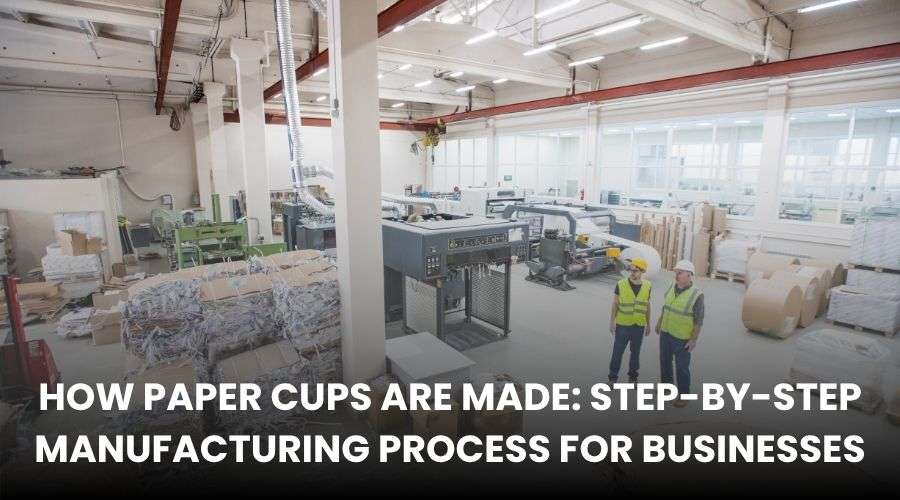
This is the main production line. The machine takes printed flat paper and a separate bottom reel and forms them into a finished cup in continuous motion. The process has five distinct stages.
Step 1: Sidewall Die-Cutting and Heating
The printed paper roll is fed into a die-cutting station. And the station punches out the familiar fan-shaped blanks. The shape is not a rectangle but a curved fan with precisely calculated angles so that when the two edges meet, they form a tapered cylinder.
Then the blanks pass over the heating elements at this stage. Pre-heating softens the coating slightly, preparing it for the sealing station that follows.
Step 2: Body Wrapping and Ultrasonic Sealing
The fan-shaped blank is wrapped around a tapered metal mandrel, the form that defines the cup's final shape. The overlapping side seam must be bonded.
Older machines use hot air to melt the coating and fuse the seam. Modern production lines use a newer technology called ultrasonic sealing. This method applies high-frequency vibration, typically at 20 kilohertz, to generate localized frictional heat only at the overlap point. The result is a stronger molecular bond with less energy and no charring of the paper. A weak side seam leads to leaks along the cup body. Ultrasonic control reduces that failure rate significantly.
Step 3: The Bottom Reel Punch
While the sidewall is forming, a separate reel of paper feeds into the bottom of the machine. A circular punch cuts out the base disc. The disc is slightly larger than the small end of the cup so that a small skirt of material can be folded up.
This base disc is inserted into the formed cylinder and mechanically crimped. The skirt of the disc is folded tightly against the inner wall of the cup and sealed under pressure and heat. The precision of this bottom curl is a direct indicator of factory quality. A tolerance error of just 0.2 millimeters creates a micro-channel where liquid can seep into the bottom rim. When you receive cups that leave wet rings on a table. That is a sign of inferior quality as the bottom curl is not folded with accuracy.
Step 4: Rim Curling and Top Edge Formation
The cup now has a body and a bottom, but the drinking edge is still a raw cut paper edge. To make it a proper rim, the top of the cup passes through curling tools that roll the paper outward and downward, making it into a smooth edge that does not sting the lip.
A properly formed rim has a threefold function. It provides structural stiffness so the cup does not deform when held. It creates a smooth, comfortable surface for drinking. And lastly, it forms the precise geometry that grips the lid. A rim that is too wide lets the lid slip off. A rim that is too narrow makes lidding difficult. Inconsistent rim dimensions across a batch cause lid failures that your customer will blame on you.
Step 5: High-Speed Camera Inspection
The finished cups move along a conveyor at speeds that can exceed 1,200 cups per minute. No human inspector can inspect the cups at this pace. Automated machine vision systems do this job.
High-speed cameras photograph images of each cup from different angles. Then the software algorithms analyze and compare every cup against a defined standard for pinholes, seam alignment, print registration, and rim roundness. Defective cups are identified and ejected by a precise burst of compressed air. The system can remove individual units without stopping the production line. When you ask a supplier about their rejection rate, you are asking about the sensitivity setting on this camera system. A factory running a tight tolerance discards more cups during production but ships fewer defects to you.
The Packaging Bay: Is Your Container Loaded for Survival?
A cup that is perfect, leaving the production line, can still arrive at your warehouse damaged. How the cups are stacked, sleeved, and loaded matters for your total cost.
The Stacking Logic
Cups are arranged into stacks inside the packaging area. The stacking follows a specific order and structure. Each cup sits inside the next with a microscopic air gap that prevents two problems. Telescoping occurs when cups jam together so tightly that they cannot be separated without tearing. Another issue that occurs with improperly arranged stacks is that cups stick to each other due to static. Proper arrangement makes it convenient for a food service worker to grab one cup cleanly with one hand every time.
Honeycomb Compression and Palletization
Your freight cost is calculated partly by volume. Shipping loose, poorly packed cups means that container space is underutilized, and empty space is left within the container, which you still have to pay for.
A technically competent Paper Cups partner applies compression techniques to maximize density while protecting the product. Corrugated dividers, corner supports, and precise pallet stacking patterns allow a single 40-foot high-cube container to carry over 900,000 cups safely. Given that spot freight rates on major shipping lanes have fluctuated by 55 to 70% in recent years, a 15 to 20% improvement in loading density translates into a substantial per-unit landed cost difference. When you evaluate two identical cup quotes, the packing method may explain a price gap that the raw unit cost hides.
Testing Methods: How Is "Food Safe" Verified?
Quality control is not a final check. It runs continuously alongside production. You should know the specific tests a factory performs on your production lot.
ATP Bioluminescence Swabbing
On the production floor, workers periodically swab the forming mandrels, the conveyor surfaces, and the human contact points. The swab is placed in a luminometer that measures adenosine triphosphate, the energy molecule present in all organic residues, including bacteria. A reading above 10 relative light units triggers an immediate line shutdown and sanitation procedure. This test takes 15 seconds and catches contamination before it enters a sealed carton.
Burst and Leak Testing
From every production batch, a defined sample, usually of 50 cups, is pulled for destructive testing. Each cup is filled with colored water, sealed with a lid, and placed on clean blotting paper for 24 hours. Any leakage through the bottom crimp or side seam leaves a visible stain. The batch acceptance standard for export orders is zero bleed.
Migration Testing for Regulated Markets
For shipments entering the European Union, the United Kingdom, or North America, specific migration limits apply. The lab simulates worst-case use by filling the cup with a hot, acidic simulant, similar to black coffee, and holding it at 70 degrees Celsius for two hours. The liquid is then analyzed in parts per billion for any chemical transfer from the coating or ink. A China Paper Cup Factory exporting to regulated markets holds current migration test reports for each coating and ink combination it offers. You have the right to request those certificates before your deposit clears.
Conclusion
Manufacturing a paper cup is a sequence of precise, verifiable steps. And each step decides a specific aspect of the cup. The raw material gate determines your customs compliance. The pre-press stage determines your brand's appearance. The core machine tolerances determine the cup quality and whether it leaks or not. The camera inspection takes care of the defect rate. The packing method determines your landed freight cost. And finally, the testing methods determine your legal safety position.
You do not need to operate these machines, but you need to understand whether your supplier operates them to a standard that protects your business. When you understand these seven stages, you move beyond comparing unit prices. You begin comparing manufacturing systems. That shift reduces your risk, saves you time, and gives you confidence that the container arriving at your distribution center contains exactly what you ordered.
Leave Your Comments
Recent Post